
Carrie – Annotated Bibliography

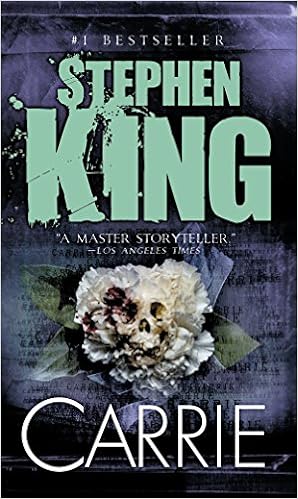
Image result for carrie stephen kingCarrie (1974) by Stephen King is a novel about a teenage girl named Carrie who struggles to fit in with two sets of opposing expectations–the expectations of her deeply religious mother, and the superficial and stereotypical expectations of her local community–which struggle then results in her destruction as well as the destruction of her mother and the local community. I didn’t get this about the book right away. I got this summary only after seeing my initial rhetorical stance and then studying the structure of the text with my rhetorical stance set aside. A rhetorical stance is what we already have before beginning to read a book, that is, we bring certain assumptions or judgments or biases about the plot, the author, or about the book in general to our reading of the book. These assumptions are what Jane Gallop (2000) calls projections, in her essay “The Ethics of Reading: Close Encounters.” There she writes that

When we read our own writing, we tend to see, not what we actually wrote, but what we intended to write–that is, we read not the words on the page, but our thoughts. Likewise, I’m sorry to say, when we read what someone else wrote, we tend to see, not what he actually wrote, but what we think he would have written […] There’s a technical term for this: it’s called projection. Rather than read what the other person has actually written, we project onto the page what we think he would have written. (10)

Projections determine how we read, or what we read for. Examples can include reading only our own thoughts. Projections compose our rhetorical stance. Avoiding projections is an important concept for the reader to employ when writing and reading because it will enable the reader to fully understand the text. Although it is very challenging to everyone, a way to see and challenge one’s projections, is to close read text. I will be doing this more carefully in part two of this annotated bibliography.

For now, I can say that the rhetorical stance I brought to my reading was given by King’s reputation, which I knew about from what everybody knows about Stephen King and his books. Everybody knows that King is one of the most famous and prolific writers of books (many of which have become films or television series). He is also famous for writing in popular genres such as horror, thriller, adventure, young adult, etc. Most important of all concerning my reading for is that King is my father’s favorite author, and this was my first real introduction to this author. I was first introduced to Stephen King’s books throughout my childhood. As I would retrieve items from the office, I would see scattered Stephen King books among our bookshelf. When talking to my dad, I learned that he is a fan of his novels. He expresses that his favorite book written by King is Stand. He emphasizes that he likes reading King’s novels because of his different genres and forms. He explained that he was interesting in King’s incorporation of good versus evil in the Stand. Growing up with lingering knowledge about King, I was influenced to read one of his books.

The first rhetorical stance that I ‘read for’ in Carrie derives off of my projections of Stephen King’s writing style. My projections on Stephen King’s writing style were formed from the opinions and thoughts of friends and classmates who have read his work. When choosing the book to read for How Writer’s Read I initially selected Carrie because it is written by Stephen King. I wanted to understand why my dad liked his books so much, and why his books were so popular. People I have talked to before often emphasized that his novels were scary or suspenseful. Although these projections were powerful upon reading for genre, I found that they did not impact my reading of Carrie. I found when actually reading his words, details, and story, I first-hand experienced his cutting and raw detail. Reading his words, instead of taking the opinions of others to mind allowed me to closely read his story through his use of details, tropes, and different methods. Through King’s words, I became a part of the story. His words enabled me to see Carrie’s blonde hair and pale skin, and understand Carrie’s thoughts and actions by his specific vocabulary and details.

King (1974) describes Carrie when Tommy talks to her  for the first time

The day was overcast and the bank of fluorescents embedded in the ceiling was not particularly kind to her pale complexion. But he saw for the first time (because it was the first time he had really looked) that she was far from repulsive. Her face was round rather than oval, and the eyes were so dark that they seemed to cast shadows beneath them, like bruises. Her hair was darkish blonde, slightly wiry, pulled back in a bun that was not becoming to her. The lips were full, almost lush, the teeth naturally white. Her body, for the most part was indeterminate”. (100)

King continues through the the text, describing Carrie’s clothes. I read for King’s rich detail, describing any element his brain could imagine.  Another element I noticed through King’s text was his use of similes. In this quote, he uses the details of Carrie’s tired skin, and compares it to bruises. When reading, I found this simile to help me by enabling myself to imagined the color of bruises under Carrie’s eyes. I could see the black, and blue puffy skin drooping under her eyes.

Through my group’s discussion and first blog post, we became interested in the Margaret White’s beliefs. We learned that the Christian religion ultimately took over Margaret White, Carrie’s mother life. She would practice the religion through her morals and forced it upon Carrie.

King (1974) reveals Margaret White’s dedication to her religion

Momma held worship on Sundays, Tuesdays, and Fridays. These were called Holy Days. Momma was the minister, Carrie the congregation. Services lasted from two to three hours. (61)

My reading group read for Margaret White’s obsession with religion. I thought Margaret White was infatuated with religion because of her constant references to the bible, god, and sinning. I also thought this was unusual because she would often take her obsession and force it upon Carrie. When Carrie did not want to practice the religion with her mother, she would punish her physically by hitting or kicking her She would also take Carrie to worship when she thought Carrie was sinning. Margaret White set high standards for Carrie and often punished Carrie for not following her directions. Carrie and Margaret White’s relationship often is defined by religion and the tragedy of Carrie’s father which lead to Margaret White’s breakdown. The novel portrays Margaret’s behavior and mental state as a product of the death of her husband, Carrie’s father. The novel reveals that her husband died from a construction accident. This tragedy left Margaret White in a unhealthy mental state, unable to fully care for Carrie.

The mistreatment of Carrie White from both her mother and the community enables me to create the premise of the story. I was introduced to the premise in  Robert McKee’s (1997) Story: Style, Structure, Substance. He defines premise in his sixth chapter

A Premise, however unlike a Controlling Idea, is rarely a closed statement. More likely, it’s an open-ended question: What would happen if…? (113)

McKee reveals the premise in the shape of a question, enabling the opportunity for discovery. The phrase included in the premise “What would happen if…?” acts a guide to engage in the story. With the premise I can recognize the growth and development of Carrie White. The premise that I created for Carrie includes: What if the person being bullied got powers and took revenge? I discovered how the mistreatment of Carrie White affects her and eventually leads to the destruction of herself, her mother, and the community.

Another factor of the creative process includes the controlling idea.  Robert McKee (1997) introduces the elements of a controlling idea

A CONTROLLING IDEA may be expressed in a single sentence describing how and why life undergoes change from one condition of existence at the beginning to another at the end. The Controlling Idea has two components: Value plus Cause. It identifies the positive or negative charge of the story’s critical value at the last act’s climax, and it identifies the chief reason that this value has changed to its final state. (115)

McKee emphasizes the controlling idea acts as the theme of the story, but in terms that it involves both the central idea and function. He demonstrates through the text that it differs from the general term of a theme in regard to what is most relevant in the story, deriving from the premise.

When thinking about controlling factors that govern Carrie my group thought of the controlling idea: “If you stay pure, you’ll obtain salvation”. Through this controlling idea, we identified staying  pure leads to and causes salvation.

McKee (1997) demonstrates the meaning of the value within the controlling idea

Value means the primary value in its positive or negative charge that comes into the world or life of your character as a result of the final action of the story. (116)

When creating our controlling idea, we immediately connected value to Margaret White’s own self-values. Her self-values include the morals of Christian faith. Through the text we recognize Margaret’s infatuation with religion, by her practices of worship and her demands of Carrie. We recognize Margaret White’s unusual values and morals when accusing Carrie of sinning when getting her first menstrual period.

Momma had been walking toward her, and now her hand flashed with suddenly limber speed, a hard hand, laundry-callused and muscled. It struck her backhand across the jaw and Carrie fell down in the doorway between the hall and the living room, weeping loudly. “And God made Eve from the rib of Adam,” Momma said. Her eyes were very large in the rimless glasses; they looked like poached eggs. She thumped Carrie with the side of her foot and Carrie screamed. “Get up, woman. Let’s us pray to Jesus for our woman-weak, wicked, sinning souls(King, 1974, 62).

In this except, she is physically punishing Carrie by punching and kicking her. She then leads Carrie to the place of worship, to pray away Carrie’s accused sins.

Ultimately the value derives from the final action of the story because it is one of the reasons Carrie does not fit in with her classmates and society in general. They make fun of her because of her physical appearance,  which is controlled by her mother’s actions and demands, and because of their knowledge of the White family. Her classmates believe that the White’s are unusual and crazy from the mothers doings. The final action derives from the value because Carrie abuses her telekinetic powers to seek revenge on any one and thing that has ever hurt her. She kills the majority of her town — including her mother, classmates, and teachers–. But realizes, that not everyone is out to hurt her. She does not kill classmate, Sue Snell due to her telekinetic thoughts. Sue Snell is ultimately saved in the end because she was kind to Carrie through her bullying and torment from her classmates and the community.

When thinking about the cause of Carrie’s struggles fitting in classmates and the community; I determined that Margaret White’s values and morals govern Carrie’s overall treatment from Margaret and the community.

McKee (2010) defines the cause of a controlling idea

Cause refers to the primary reason that the life or world of the protagonist has turned to its positive or negative value. Working back from the ending to the beginning, we trace the chief cause deep within the character, society, or environment that has brought this value into existence (116).

Within the controlling idea, we derive our ideas off of Margaret White’s perspective. If Carrie practices and supports the Christian religion, then she will will ultimately go to Heaven. Ultimately, obtaining salvation through the Christian faith acts from a positive value, which in this cause it is staying pure.

Our counter argument, which is the opposite of the controlling idea includes: “If you sin, you’ll lose eternal salvation”. From Margaret White’s perspective, we see in the novel how Carrie sins. Carrie sins in her mother’s eyes when she disobeys her rules, gets her period, and when she talks back to her mother.

Towards the end of the novel, we learn that Margaret White punishes Carrie for going to the prom with Tommy.

Mrs. White sat trembling, her face frozen except for her nostrils, which continued to flare. Abrupt she threw back her head and screamed at the ceiling. “God! God! God!” Her jaw snapped brutally over each syllable. Carrie sat without moving. Mrs. White got up and came around the table. Her hands were hooked into shaking claws. Her face bore a half-mad expression of compassion mixed with hate. “The closet,” she said. “Go to the closet and pray.” (King, 1974, p. 113)

Margaret White believes by praying it will bring Carrie repentance to her actions. She believes Carrie action’s reflect sinning and disobeying the Christian faith.

The counter idea reflects Margaret White’s own perspective. We see in the novel her thoughts about sinning. If Carrie sins, then she will go to Hell. The counter idea demonstrates the negative charges of the values in the story. By practicing the Christian faith, she believes she will be pure and eventually go to Heaven. Her thoughts of sinning and disobeying the faith leads to the negative value of losing eternal salvation.

Although I have primarily discussed Margaret and Carrie White’s relationship, Carrie also had other relationships in the novel. As revealed briefly earlier, we were introduced to Sue Snell. We were first introduced to Sue Snell as one of the popular, mean girls in the story. As we read, we learned that Sue is the opposite. Sue’s character changes drastically, and is one of the only characters that cares about Carrie’s feelings. Through our blogs, my group found it interesting to map out their friendship in a value graph. The value graph is used as a tool to understand the text identify specific instances that reveal positive and negative values in the story.

On the How Writer’s Read webpage, Andrew Kopp explains details about the value graph

Attempting to graph the values of a text involves us in a  recursive process that requires the reader to engage in a conversation with the various pieces or “units” of a text in order first to comprehend how the text works, and second, to generate various interpretations grounded in such a comprehension, but that move beyond comprehension of the mimetic and diegetic/thematic aspects of the text and toward critical possibilities.

When creating value graphs, it is important to select pieces from the text that reflect positive and negative values. The positive and negative values, will help the reader understand the characters and plot. Value graphs are also beneficial because they will help the reader analyze the characters actions and the methods in the text.

The value graph for Carrie White and Sue Snell’s formed friendship, began with the negative value of Sue making fun of Carrie. We are first introduced to Sue when she bullies Carrie in the locker room. She bullies Carrie by laughing at her and throwing tampons at when Carrie getting her period for the first time.

After this incident, the value graph rises revealing a positive value. It rises when Sue Snell forms remorse for her actions among Carrie. By seeking penance, Sue convinces her boyfriend, Tommy to take Carrie to the prom. She hopes this will make up for her actions.

The graph then decreases at the prom. Although Carrie begins liking Tommy, an incident occurs that changes her whole perspective. She is tormented by her classmates and gets pig’s blood dumped on her on stage. Even though this is not Sue’s fault, she caused Carrie to go to the prom.

For the final climax of the novel, the graph rises again in Sue’s favor. When Carrie gets pig blood dumped on her, the destruction to herself, her mother, and the community unleashes. Carrie’s anger and telekinetic powers causes power outages, fires, explosions, and deaths through her community. We learn that Carrie eventually kills her mother by stabbing and stopping her heart. Carrie also gets stabbed by her mother and fights to stay alive. At the end of the novel, we are presented with Sue Snell’s encounter with Carrie. The novel reveals how Carrie saves Sue by not killing her.

 (look carrie look inside me) And Carrie looked. The sensation was terrifying. Her mind and nervous system had become a library. (King, 1974, p. 274)

Through telekinetic messages, Carrie looks inside Sue’s mind and learns that Sue was not a part of the prank. Sue also displays a positive value when the text shows her investigation about the prom.

The value graph ultimately dissects specific characters or instances through the novel. It has helped me as a reader comprehend elements from the text.

In the next section, I will discuss the Carrie White’s telekinetic powers. Briefly mentioned in the first section, Carrie’s powers caused the last climax of the novel, resulting in mass destruction by killing herself, her mother, and the community of Chamberlain. In Carrie, Carrie White  uses her powers when she is upset, angry, or embarrassed. These emotions overpower Carrie, which leads to her use her powers and cause destruction. Through the novel, Carrie’s actions of getting upset and causing destruction becomes a pattern. As this theme of these two actions occurring progresses within Carrie’s actions, my group inferred that this novel demonstrates the qualitative progressive form. In Kenneth Burke’s (1931) book Counter Statement he reveals the five aspects of form, which includes the qualitative progressive form.

Burke (1931) states

The five aspects of form may be discussed as progressive form (subdivided into syllogistic and qualitative progression), repetitive form, conventional form, and minor or incidental forms. (124)

Burke reveals form is demonstrated through sequences and steps. Within these five types of forms, writers can learn in which ways they write in form. In Carrie, the plot demonstrates the qualitative progression form because it includes an action, that helps us prepare for the next action that follows.

Burke (1931) identifies qualitative progression

Qualitative progression, the other aspect of progressive form, is subtler. Instead of one incident in the plot preparing us for some other possible incident of plot (as Macbeth’s murder of Duncan prepares us for dying of Macbeth), the presence of one quality prepares us for the introduction of another (the grotesque seriousness of the murder scene preparing for the grotesque buffoonery of the porter scene). (124)

Qualitative progression differs from syllogistic progress– which directly connects two incidents together– by enabling the reader to enter a different mood or state of mind. These moods or state of minds will directly follow the action from the text. Qualitative progression is also referred to as foreshadowing. It is considered foreshadowing because one quality prepares us for the introduction of another (Burke, 1931, p. 124). When foreshadowing through the text, we would be given an indication of future incidents or actions.

When discussing form and genre with my reading group, we discovered that Carrie’s emotions and feelings set a foundation of the future of the novel. In other words Carrie’s feeling and emotions, and incidents from the novel foreshadowed the ultimate destruction in the last climax of the novel.

King (1974) demonstrates the qualitative progressive form

But Ms. Horan still carries the thin, difficult soil of New England somewhere inside her, and when she talks of Carrie White her face takes an odd, pinched look that is more like Love-craft out Arkham than Kerouac out of Southern Cal. “Of course she was strange,” Estelle Horan tells me, lighting a second Virginia Slim a moment after stubbing out her first. “The whole family was strange. Ralph was a construction worker, and people on the street said he carried a Bible and a .38 revolver to work with him everyday. (31)

Image result for carrie the novelIn the beginning of the novel, I learn that Carrie White and her mother, Margaret White carry negative connotations in their community. Ms. Horan, a former neighbor of the White’s discusses her thoughts about them. We explains by assuring that Carrie was strange and continued to talk about the rest of the family including Margaret White and Ralph White. Through this early interaction, Mrs. Horan’s concerns of Carrie, foreshadows the bullying and Carrie’s revenge. Mrs. Horan’s opinions on Carrie and her family enabled a concerned state of mind for myself as a reader. I wondered why do people think Carrie is so strange? Through the novel, I learned that people thought Carrie was strange because of her family reputation and her appearance.

Other instances of form occurred by foreshadowing events from Carrie White’s Prom Night. The text reveals events and details about Prom Night before they were discussed in the novel. These instances allows me to prepare for the actual event of Prom Night. King (1947) reveals an excerpt from Sue Snell’s perspective.

There’s one thing no one has understood about what happened in Chamberlain on Prom Night. The press hasn’t understood it, the scientist at Duke University haven’t understood it, David Congress hasn’t understood it […] This one thing is the most fundamental fact: We were kids. Carrie was seventeen, Chris Hargensen was seventeen,  I was seventeen, Tommy Ross was eighteen, Billy Nolan (who spent a year repeating the ninth grade, presumably before he learned how to shoot his cuffs during examinations) was nineteen… (95)

Including an excerpt from Sue Snell’s fictional book, My Name Is Sue Snell, King reveals Sue’s perspective of Prom Night before it occurred in the book. This occurred on page 95 and the details of Prom Night unfolded beginning on page 177. Sue explains when looking back at the event, she realizes that they were all kids. By including this in her book, she hopes people would understand her perspective on the situation. She blames her youth and innocence of how she treated Carrie, and how the events took place in her adolescence.

When reading this, I believe this incident prepared me for the introduction of the Prom Night chapter. I used background knowledge from Sue Snell, to understand what occurred during Prom Night. From Sue Snell’s book, I created a state of mind knowing that something important was going to occur later in the novel.
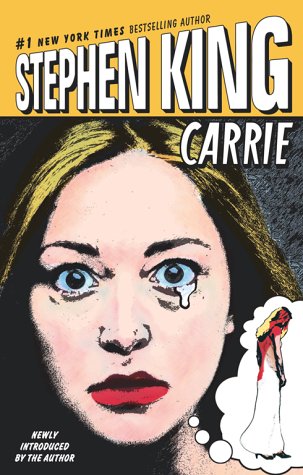
Image result for carrie the novelFor the third section, I will connect events discussed in earlier sections– like Prom Night and other elements– to create intertextual connections within Carrie. When discovering intertextual connections in Carrie, I found many incidents that display cultural connotations and codes. In Carrie, I believe cultural connotations and codes are significant to the plot. Carrie White is ridiculed by her mother and community for not following expectations. From her mother, Carrie is not following the Christian faith. Within the community, Carrie is not following societal expectations because of her appearance, lifestyle, and family. These connotations are defined through Kaja Silverman’s (1983) Subject of Semiotics, chapter 6 “Rewriting the Classic Text”

In Mythologies, where he treats the issue most exhaustively, Barth defines connotation as a secondary operation, one which builds on denotation.  […] he identifies connotation as an agency of ideology, of what he in his early writings calls “myth”. In other words, Barthes argues that connotation naturalizes history, that it makes a given culture seem eternal and inevitable. (238)

Through her text, Silverman derives from the ideas of profound author and theorist, Roland Barthe from his book S/Z, explaining the meaning of a connotation. She explains how Barthe identifies connotation as a myth, coming from ideas and beliefs. Connotation can be seen through Carrie when her classmates decide to throw pig blood on Carrie at Prom. King (1974) reveals the reason for pig blood

Carrying the pails back back to the trunk, his mind made a dim, symbolic connection. Pig blood. That was good. Chris was right. It was really good. It made everything solidify. Pig blood for a pig. (136)

Classmates of Carrie White, Chris Hargensen and Billy Nolan who form a hatred for Carrie, seek vengeance for Carrie by dumping pig blood on her. They dump pigs blood on her when she receives Prom Queen. They choose pigs blood because they look at Carrie like she is a pig.

Through association, pigs are known for being dirty and smelly because of their habitat. They bathe in mud and are raised in farms. From this ideology, Chris and Billy decide Carrie to dump pig blood on her because in their eyes, they look at Carrie with disgust. Although Chris was on the fence about humiliating the prank, she did it because she thought Carrie deserved pig blood. These cultural connotations can also be reflected into codes. Silverman (1983) reveals the connection with codes

As Barthe explains in S/Z, a code represents a sort of bridge between texts. Its presence within one text involves a simultaneous reference to all of the other texts in which it appears, and to the cultural reality which it helps to define- i.e. to a particular code. (239)

Codes are useful literary devices because they connect texts with other texts. This is also called intertextuality, in which it can help readers better understand the text because of references. Through Carrie, I have identified many cultural codes. Silverman (1983) defines cultural codes

Barthe underscores the discursive basis of the “reality” to which the cultural codes refer […] The cultural codes provide the means whereby the “information” contained in the authoritative texts of a given symbolic order finds its way into novels, poems, and films which perpetuate that order (274).

She explains how cultural codes come from associations created from reality. This ideology derives from that have been done or seen in society. Culture reality is often seen within text by societal standards, symbols, or stereotypes. Cultural codes are demonstrated through Carrie’s struggle with fitting in with societal expectations. Mentioned before through my sections, Carrie White gets tormented in the book by her classmates because she has a strange reputation from her religious family, and her appearance. Seeking penance for bullying Carry before, Sue Snell wants to do something nice for Carrie. She decided to ask her popular boyfriend, Tommy to take Carrie to the prom. King (1974) includes Sue Snell’s perspective on Carrie

Lots of kids say they feel sorry for Carrie White–mostly girls, and that’s a laugh- but I bet none of them understand what it’s like to be Carrie White, every second of the day. And they don’t really care. (98)

After a change of heart, Sue realizes Carrie is just like everyone else. She does not deserved to be bullied. She tells Tommy how other people perceive Carrie and how wrong it is. Sue hopes to make Carrie feel happy and accepted.  Although Carrie’s night ends with destruction, Sue tried to help Carrie fit in with Chamberlain’s societal expectations.

Image result for carrie the novelFor the last section, I will focus on the rhetoric dimensions introduced in Carrie. I thought one of the most interesting elements in the novel is how King included multiple narrators. From these elements, I can experience different perspectives about Carrie White and Prom Night. I never read a book with more than two narrators. I believe it was beneficial as a reader to experience multiple narrators because it added depth to the scientific part about Carrie White. The text included narrators including Carrie White, Margaret White, Sue Snell, Ms. Desjardin, scientific articles etc. James Seitz (1992 ) article, “A Rhetoric of Reading discusses the relationship with the narrator, addressee and the reader” suggests

Reading, like dialogue, constitutes a form of social engagement which consists of both reception and participation–a notion for which Pratt convincingly argues in her description of ‘the literary speech situation’, wherein both writer and reader rely on an established role structure commonly understood to be in force. Readers, for instance, accept the imposition ‘giving up the floor’ (as an audience does for a speaker), with the understanding that they have the right to interpret, respond and evaluate. (143)

Understanding dialogue in texts is a crucial part when reading because it is a social process. It is a social process because it is information that is shared with the reader. The dialogue expresses to readings who is speaking as the narrator and who the addressee is within the text. The reader relies on the text to be engaging through the characters, dialogue and plot.

I believe Carrie is very engaging for the reading because it includes identifiable narrators, addressees, and relationships with the reader. As mentioned earlier, Carrie includes many scientific evidence among Carrie White’s powers and life story. I believe due to these scientific sources, interviews, and information about Carrie White, the addressees are people who are researching Carrie. It is mentioned repeatedly in the book how Carrie White’s Prom Night is a famous and historic event within Chamberlain. I believe the book is set up to share Carrie White’s story and her impact on Chamberlain. King (1974) includes an excerpt from The Lewinston Daily Sun, one of the fictional newspapers

Chamberlain– Prom Night is history now. Pundits have been saying for centuries that time heal all wounds, but the hurt of this small western Maine town may be mortal. (282)

The novel portrays Prom Night as one of the most historic and deadly events occurring within the community. It also reveals Carrie White killed 440 people through her destruction.

Before this course, I was not familiar with the methods that were presented in class. I believe after listening to and engaging in lectures about these methods, I have developed a better understanding of how they are applying in writing. I also believe through the blogs and reading the books for the blogs, I learned how to apply them in my own writing. Although, applying them in my own writing was one of the most challenging aspects of this course for me, I tried my best to understand them and become a part of the readings and methods within the text. I believe with practice, I will eventually be able to successfully apply them to my readings and writings.

As for growth, I believe this class has overall made me a better reader and writer. Reflecting on core value three, this class has strengthened my skills in close reading. I notice as a read articles, books, and other sources I look and notice elements that I have not noticed before. For example,  this includes Jane Gallop’s idea of projections, or the controlling idea derived from the ideas of Robert McKee. Utilizing core value two, I learned about different theories and methods. I studied these theories, by listening to lectures and rereading the text, until I grasped the concept of the methods.

Reflecting from core value one, this course enabled me to read different genres that I have never experienced before. Stephen King’s Carrie was the first horror book I have read. Call Me By Your Name was the first gay-romance novel I have read. Through these genres, I had the opportunity to explore different forms. I learned how to apply the qualitative progression form through my readings. For Carrie, I learned how Carrie’s feelings transformed into destruction, exemplifying foreshadowing. Through the Glass Castle, I was introduced to the conventional form. This form allows me to explore all of the unconventional details about the Walls family.

Even though this class served as a great challenge to my writing skills, I am grateful for the opportunity to have been a part of the class. With the blogs and methods, I believe I tried my best to engage with the material and the projects. As a continue my Writing Arts career, I plan to use the methods and theories to make connections through text and strength my writing skills. How Writer’s Read has challenged my skills in many ways but has also influenced me to become a better writer and reader.

References

Burke, K. (1931). Counter Statement. 

Gallop, J. (2000). The Ethics of Reading: Close Encounters.

King, S. (1974). Carrie. New York, NY: New American Library.

McKee, R. (1997). Story: Substance, Structure, Style. New York: ReganBooks.

Seitz, J. (1992). A Rhetoric of Reading discusses the relationship with the narrator, addressee and the reader.

Silverman, K. (1983). The Subject of Semiotics. New York: Oxford University Press.

Blogs

First blog: https://howwritersfeed.wordpress.com/2018/10/01/carrieblog-i-the-introduction-to-carrie-white/

Second blog: https://howwritersfeed.wordpress.com/2018/10/04/carrie-blog-ii-telekinesis-and-religion/

Third blog: https://howwritersfeed.wordpress.com/2018/10/09/carrie-blog-iii-trying-to-fit-in/

Fourth blog: https://howwritersfeed.wordpress.com/2018/10/11/carrie-iv-who-is-speaking/

Girl in Pieces Annotated Bibliography

Girl-in-Pieces

This semester, I picked Girl in Pieces as one of the four books my reading group and I would tackle this semester. In Girl in Pieces, published in 2016, Glasgow gives us a story of a young woman struggling to recover from past trauma leaves her old life behind and finds a way to become a healthier, happier person.

We find the premise of Girl in Pieces by first looking at McKee’s definition of what a premise is.

Premise, the idea that inspires the writer’s desire to create a story (McKee, 1997, 112).

Therefore, we find this premise for Glasgow’s novel: What if a hurting teenager found a way to not only survive, but thrive and not let her past dictate her future?

Moving onto the controlling idea, McKee defines it as

the story’s ultimate meaning expressed through the action and aesthetic emotion of the last act’s climax (McKee, 1997, 112).

By using McKee’s process of looking at the last act’s climax in order to define the controlling idea, we find this:“If you accept yourself and your flaws while letting go of the past, you’ll grow as an individual and find resources for recovery.”

I don’t have a tender kit anymore. I’m walking into life unprepared for the first time in a long time (Glasgow, 2016, 396).

By overcoming her vices and letting go of the past, Charlie finds freedom she didn’t have before, which gives her room to continue on her journey to recovery.

By putting the controlling idea in juxtaposition with the counter idea, I defined the counter idea as:“If you’re stuck in the past, there’s no chance at improving your present state. You’ll only regress back to where you started out at.”

I want Ellis, the Ellis who would dab my cuts and steal wine from her dad so we could cry together in her room, sipping from the bottle and listening to our music (Glasgow, 2016, 45-46).

By not letting Ellis go and continuing to focus on the memories of them together, Charlie prevents herself from progressing further into her recovery.

Like I feel when I think about Ellis, and even that, really, isn’t true, because while I say sadness what I really mean is black hole inside me filled with nails and rocks and broken glass in the words I don’t have any more.

Ellis, Ellis (Glasgow, 2016, 20).

Now, upon rereading parts of Girl in Pieces, I think that my values can be defined more in-depth.

The controlling idea I found was:“If you let go of the past and focus on your future, you’ll grow as an individual and find support in places that you didn’t expect.”

This is reflected in the physical reality of Charlie’s body; her body is covered in self-inflicted scars. It’s not until after she’s institutionalized that she’s healed enough to have her bandages removed. That’s when she sees the true altered state of her body.

Ugly, I tell her, my voice still muffled and my face hidden by the hood. Ugly. It still feels ugly (Glasgow, 2016, 51).

…you can never not be a creepy freak, because your whole body is now a scarred and charred battlefield (Glasgow, 2016, 31).

Not self-sabotaging her life was a struggle, especially when it came to her thinking badly about her body and how people would see her now. McKee says that

“Reality is relentlessly ironic, and this is why stories that end in irony tend to last the longest through time, travel the widest in the world, and draw the greatest love and respect from audiences” (McKee, 1997, 128).

Charlie’s story is reflective of what a lot of us go through. We want to have positive outlooks on ourselves and not care about what people think, but such things are easier said than done.  McKee reminds us that

“…life is rarely all sunshine and strawberries, nor is it all doom and drek; it is both” (McKee, 1997, 128).

Chris saw that there were times when Charlie helped herself instead of self-sabotaging. Going through treatment and moving away from her mother was a positive change in her life, helping her move forwards instead of backwards. Although later on, she does experience more of the positive and negative charges that McKee has drawn out for us on page 123 of his work.

I’d classify this controlling idea-“If you let go of the past and focus on your future, you’ll grow as an individual and find support in places that you didn’t expect”-as an “ironic controlling idea.” McKee says that

“‘up/down-ending’ stories expressing our sense of the complex, dual nature of existence” (McKee, 1997, 125).

Charlie’s story has happy moments and sad moments, even if they’re not proportional to each other. (Sometimes the sad moments outweigh the impact of the happy moments.) But that’s a realistic situation. Our lives are a mixture of the good and the bad. Her life, like McKee says, is part of the complex, dual nature of existence.

“The effect of irony on an audience is that wonderful reaction, ‘Ah, life is just like that.’ We recognize that idealism and pessimism are at the extremes of experience” (McKee, 1997, 128).

Charlie’s story rang true for Kyra’s own experiences. Kyra wrote that:

You are right, our lives are a mixture of the good and the bad. This book really personifies that. As I shared in the blog dump, and as you mentioned in the beginning of this blog, I have had similar experiences. I struggled with self harm for years, sexual abuse, suicide attempts, being admitted into hospitals and dealing with so many different types of personalities, problems and people. I feel like I can open up here in the comments in sharing that because reading this book has really made me shed light on my own pathway to recovery. It is something I feel like should be talked about more in the healing process. And it is a really long road. But I, too, am rooting for Charlie. I think of us, the readers, as her cheerleaders. Her friends and family who support her through this difficult time just as mine did. I am so happy that we are reading this book because it really helps me to not feel alone in my experiences, even if they aren’t the same exact ones (Kyra, 2018).

While reading Girl in Pieces, Baillie had some thoughts about another controlling value she found present in this book.

It is interesting to see how as readers, we can make personal connections to stories, that do not involve ourselves, but involve similar certain aspects of our lives. Also, even though this book does revolve around accepting true identity, I believe there is also another controlling value present. The controlling value that I found while reading this book was, if you persevere through life’s challenges, then you will find recovery and solutions (Baillie, 2018).

The counter idea I found was:“If you hold onto your past and let it define your future, your individual growth will be stunted and you risk staying isolated.”

Charlie constantly relives the negative aspects of her past. One aspect of her past that she focuses on is “Fucking Frank.”

Just do it, Fucking Frank said that night, my breath disappearing in the tightness of his fingers. Do it, like the other girls. Or I’ll do you myself (Glasgow, 2016, 38).

By letting herself constantly think about everything that’s gone wrong in her life, she has a hard time even allowing herself to imagine a better future. This man was a negative, destructive force in her life. So now, even though she’s out of his (physical) grasp (or so she hopes), mentally she’s not out of his grasp. She’s still trapped back in that place, even though her body is somewhere else. Even when she’s talking to other people, part of her attention is still devoted to these harmful memories.

I should have known when Fucking Frank greeted us at the door that he wouldn’t let me stay for free. I should’ve looked closer at the faces of the girls on the ripped couch as Evan and Dump carried me in. (Glasgow, 2016, 38).

Throughout remembering these things and reliving them, she struggles not to disassociate on a daily basis. There’s so many harmful memories battling to be the dominant image in her mind’s eye.

Cut out my father. Cut out my mother. Cut out missing Ellis. Cut out the man in the underpass, cut out Fucking Frank, the men downstairs, the people on the street with too many people inside them, cut out hungry, and sad and tired, and being nobody and unpretty and unloved, just cut it all out, get smaller and smaller until I was nothing (Glasgow, 2016, 38)

Seeing how Charlie struggled with both her internal world and her external world hooked me and kept me on the edge of my seat for the entire book.

When we moved on to the next part of our analysis, Rachel’s blog looked at the importance of language and what role repetition plays plays in emphasizing the emotions or associations in Girl in Pieces.

Repetitive form is the consistent maintaining of a principle under new guises. It is restatement of the same thing in different ways (Burke, 1957, 125).

Through Burke’s Counter-Statement, we see that there are five aspects of form. Rachel focused on minor and incidental form for this particular analysis.

Their effect partially depends upon their function in the whole, yet they manifest sufficient evidences of episodic distinctness to bear consideration apart from their context (Burke, 1957, 127).

Rachel points out that Girl in Pieces, we’re given a lot of similes, but that they’re not all together. There’s some sections bursting to the seams with similes, while other sections are barren of them. This made us wonder why, so we started by looking at the first page to see what comparisons we could find there.

Like a baby seal, I’m all white. My forearms are thickly bandaged, heavy as clubs (Glasgow, 2016, 1).

There’s a whole lot going on with just these two lines. There’s the comparison between the color of her bandages and the color of a baby seal, but if we look at it differently, we also see multiple other similes. The one that I thought was the most interesting is the juxtaposition between clubs and baby seals: Clubs kill baby seals without damaging their fur. While the clubs are meant to preserve the fur, Charlie’s self-harming damages her.

The rest of the page exposes the truth of her situation: The concept of being an orphan on the basis of having no clothing. (She arrives at the hospital wrapped in a sheet.)

Like an orphan, I came here with no clothes. Like an orphan, I was wrapped in a bedsheet and left on the lawn of Regions Hospital in the freezing sleet and snow, blood seeping through the flowered sheet (Glasgow, 2016, 3).

Then there’s the comparison between the stars and salt.

But: I remember the stars that night. They were like salt against the sky, like someone spilled the shaker against very dark cloth (Glasgow, 2016, 3).

To Kyra, the “salt shaker in the sky” simile really stuck with her.

There is darkness inside and outside of her. But the salt, these stars, are her binding hope of beauty and reform (Kyra, 2018).

I admit that these similes in the beginning of Girl in Pieces didn’t affect me as strongly during the first read as I’d hoped they would. I know now that I didn’t get a strong impression of these similes because I wasn’t engaging in close reading. Instead, I was just reading on a surface level and therefore missing out on a lot of other stuff. I wrote in the comments of this blog that:

I was reading on the surface level of “oh, she’s physically hurt. She’s impaired as a result. Being all wrapped up and bandaged must be really depressing”

But now that I’m armed with Rachel’s analysis of the text and my own close reading, I came to a better understanding of the similes in the text. Now they have a deeper emotional impact on me.

When we moved onto intertextual codes, Kyra focused on the semic code for her analysis. Silverman defines the semic code as follows

The semic code represents the major device for thematizing persons, objects, or places (Silverman, 1983, 251).

Kopp furthers Silverman’s explanation by adding

Because this code defines characters, objects and places, the semic code sets up relationships of power that often reinforce cultural codes (Kopp).

So here, we once again look at repetition, but through a different angle. In the previous blog post, repetition was key in emphasizing emotions and associations in Girl in Pieces. During this analysis, however, repetition here was used to show which words and phrases were important to Charlie. Baillie liked that Glasgow did this, and said,

When reading, I liked how the author used repetitive phrases and words. I think utilizing these words and phrases, will make the reader understand why they’re so important in Charlie’s life. (Baillie, 2018).

One phrase we focused on during our analysis was “Fucking Frank.” It makes a constant appearance throughout Charlie’s narrative, especially in the beginning. Just through the repetition of one single word, we aren’t left with any room to doubt how Charlie feels about this man. Because he’s not just “Frank”, he’s “Fucking Frank.”

Fucking Frank and his black eyes and those rings. Seed House and the red door where girls disappeared (Glasgow, 2016, 63).

Silverman reinforces this by saying

Barthes refers to the signifiers which provide another signifier with its semantic values as ‘semes.’ He insists that the same signifiers must attach themselves to a proper name more than once before the connection becomes permanent (Silverman, 1983, 252).

This means that Charlie’s narration has to include “Fucking Frank” more than once for it to take effect. On page 38, the phrase “Fucking Frank” is used four times.

I should’ve known when Fucking Frank greeted us at the door that he wouldn’t let me stay for free (Glasgow, 2016, 38).

To Kyra, this use of “Fucking Frank” was a strong example of how important repetition is. She writes near the end of her blog that

Once our eyes see the words ‘Fucking Frank’ put together, we don’t have to read whatever comes after it to know that it is a bad association. There is nothing good that becomes of that phrase linked together (Kyra, 2018).

It’s amazing how we as writers need so few words to make the biggest impact. The way Glasgow weaves Charlie’s narration and makes use of the semic code had us rooting for Charlie throughout all of her mistakes and hardships. And, like Kyra said, we all hoped that Charlie would never have to encounter Fucking Frank or anyone like him for the rest of her life.

When we went on to start our last portion of analysis for Girl in Pieces, we focused on the Rhetoric of Narrative. (Defined as “Narrators, addressees, and reading the relationships between them.”) It was during this that Baillie defines who the narrator of Girl in Pieces is and solidifies the reliability of Charlie’s narration. In terms of defining the narrator, Baillie wrote:

From the start of the book, Glasgow begins Charlie’s story by writing in short scenes, exhibiting to readers evidence that supports Charlie as the narrator (Baillie, 2018).

There is no doubt that Charlie is the narrator because Glasgow writes her narration using “I”, “me”, and “my” pronouns.

I wasn’t scared. I’d just never seen a girl with skin like mine (Glasgow, 2016, 5).

Baillie went on to analyze Charlie’s narration and the reliability of it through Peter J. Rabinowitz’s work on the matter.

“Questions about the status of literary truth are as old as literary criticism, but they have become both more intricate and more compelling as literature has grown progressively more self-conscious and labyrinthian in its dealing with “reality”(Rabinowitz, 1977, 122-123).

While I was reading Girl in Pieces, I thought that the possibility that Charlie’s narration wasn’t entirely truthful made it a very interesting read. Her bias led me to believe that things would go differently than they did. This is what I had to say about the situation in the comments:

It’s not until we read Mikey pulling away from her, physically and emotionally, that we realize Charlie’s bias blinded not only us, but her as well. Then, when she and Riley West met, I started to believe that she’d have a second chance at love. But everything seemed too perfect. Soon enough, the dark secrets come out: Charlie’s a recovering self-harmer; Riley West uses and is inebriated a majority of their time together; Charlie does her boyfriend/not boyfriend’s drug runs and feels guilty for enabling him. The toxicity of their relationship is a little depressing. Here I was, rooting for them to have the perfect happily ever after, then all the darkness comes out. Realistic? Yes. Because no relationship is ever perfect. But that doesn’t mean that I couldn’t naively hope in the beginning that things would go well. Her narration really hits me hard. Girl meets boy, girl thinks she’s found her Prince Charming, boy turns out to be a Beast. (Forgive my metaphors jumping in between fairy tales!)

In the end, Baillie concluded that Charlie’s narration was, however, reliable because the text supported Charlie’s perspective. While we see the stories of the supporting cast, the text doesn’t show us their intimate viewpoint. All we have are Charlie’s thoughts and feelings on what’s happening to her.

The girls piss and hiss about the schedule, the food, Group, the meds, everything, but I don’t care. There’s food, and a bed, and it’s warm, and I am inside. I am safe (Glasgow, 2016, 7).

We become more and more emotionally involved with Charlie as her narration progresses, rooting for her to not only survive, but to find happiness and thrive in her world. During later parts of the narration, we see Charlie during times she relapses and during times she takes a step forward in her recovery.

Let my skin soak up the lake of glass. How powerful am I? How powerful am I. I can grind the glass to my face, erase my eyes, eat glass, and disappear from the inside…I can drink it all…it feels like home (Glasgow, 2016, 342).

It’s here that we see Charlie struggling with her old vices (cutting, drinking) and ultimately relapsing, at least in that moment. It’s not until near the end of her narration that we see a light at the end of the tunnel for her.

Blue leans close to my ear. “What is the cereal doing, Charlie?”

“The cereal is not eating me.” I repeat it until she says I can stop (Glasgow, 2016, 394).

This is a moment where we as readers can finally breathe and say “Yes, things are getting better. Everything is going to be okay.” We see now that Charlie is stronger than she was at the beginning of the text. Through moving out on her own, getting a job, and creating new relationships, we see that she’s not “just” some broken, fucked-up girl. She’s someone with potential. She is someone who has a place in the world.

Blue said we have to choose who we want to be, not let the situation choose us.

Momentous, Felix said.

I’m choosing my next momentous. (Glasgow, 2016, 398).

Final reflection:

At the beginning of this class, I found myself confused by what we were working with, but I was still intrigued to learn from Professor Kopp. Once we got into We Have Always Lived in the Castle, I felt like I had no idea what I was doing, but I believe that Professor Kopp’s plan was to have us “swim or sink.” Not that that’s a bad thing! We learned very quickly by just diving right in.

I felt like I had a better grasp on things when we started reading The Glass Castle.  When I wrote “Why Tell This Story Now?”, I was more confident writing about rhetorical dimension. I was able to read with a more critical point of view on the text than I was capable of when I first started this class. I was reading more in between the lines and was battling with not placing my own projections into the text. (The latter being a difficult task!)

As Writing Arts being half of my dual major, I do my best to meet its core values. The first core value is defined on Professor Kopp’s website as the following:

Writing Arts students will demonstrate understanding of a variety of genre conventions and exhibit rhetorical adaptability in applying those conventions.

Our genres this semester were fiction, horror, and memoir. By branching out instead of just reading one genre all semester, I was able to see how rhetoric played out across each genre. I’d never learned about rhetoric this way in my community college English classes, so I definitely gained a fulfilling understanding of how rhetoric is crucial to text, and how by finding it, we gain a better understanding of the text itself.

The second core value is defined as

Writing Arts students will understand theories of writing and reading and be able to apply them to their own writing.

I definitely didn’t develop personally in this second core value until near the end of the semester. (Slow and steady wins the race.) I’m glad that I gained as much knowledge as I did during this course, because this new knowledge will be useful in future Writing Arts classes. (And probably in my psych classes as well!) At the beginning of this class, the phrase “rhetoric of narrative” scared me, but now I feel like I understand it enough to be able to apply it to other work in my Writing Arts classes. While it took awhile to grasp, it’s very useful to know how to begin defining narrators and who their audience/addressees are. Without that, we cannot fully comprehend all that a text has to offer us.

The third core value is defined as

Writing Arts students will demonstrate the ability to critically read complex and sophisticated texts in a variety of subjects.

Professor Kopp really challenged us this semester by giving us work from people like McKee and Burke to supplement our own group readings. These helped us better analyze our fiction, memoir, and horror readings for this semester. Even though some of the pieces were a bit dense (I’m looking at you, Culler.), they still provided value for us. At first, I felt so out of place doing all of this critical reading. I had even begin to question whether or not I was smart enough for this class since I didn’t always understand what was going on for the first few weeks. But in the end, I’ve come out not only as a more confident writer, but a better reader as well. Now, I’m a reader that feels comfortable jumping across multiple genres in the span of a semester and being able to analyze the readings without fear of being “stupid” or “wrong” in my analysis.

Call Me By Your Name Annotated Bibliography

Kyra Smiley

Professor Kopp

How Writers Read

Controlling/Counter Idea & Reading for

cmbyn book cover

Call Me By Your Name written by André Aciman in 2007 is a novel about two young men that slowly fall in love but don’t allow their feelings for each other to overcome them because of societal expectations.

I picked the book Call Me By Your Name in my group for the semester after seeing the movie and wanting to actually get a deeper look into the relationship between Elio and Oliver. My reading for was what I watched in the movie. In my reading for, I was searching for some sappy love story that doesn’t work out in the end. But the book is so much more breathtaking than that. Instantly I was hooked with the way the story was written and how personal it became. Considering the fact that we are in Elio’s thoughts the whole time, we watch the dynamics of the pair unfold through his eyes and sentiments. Although being gay isn’t outright said as being wrong in the novel, neither Elio nor Oliver tell others about their growing affection and love for each other and in the end don’t end up being together. Elio’s father has a talk with Elio later on in the book hinting at the fact that he knew all along.

cmbyn beach

“You’re too smart not to know how rare, how special, what you two had was”(Aciman, 223).

Riley’s reading for was instantly changed as she read on:

“I came in expecting a melodramatic romance but what I didn’t expect was this achingly slow burn that Aciman plays out through the text’s narration and shots of the two love interests” (Riley, 2018).

She continues in the blog dump by saying that she was surprised with how much narration the book uses instead of on-again/off-again dialogue back and forth. The use of almost purely narration really provides a side of the story that we might not have ever seen otherwise. Riley speaks on this aspect of the novel sharing her thoughts in that,

“The narrator’s inner monologue is much more developed than I had expected it to be” (Riley, 2018).

After reading the novel a bit more in the beginning she then comments in the second blog post,

“I definitely didn’t anticipate how poetic Elio’s narration would be” (Riley, 2018).

“I was exaggerating when I said I thought you hated the piece. What I meant to say was: I thought you hated me. I was hoping you’d persuade me of the opposite-and you did, for a while. Why won’t I believe it tomorrow morning?” (Aciman, 13).

His narration is full of teenage hormones, metaphors, and angst.

“We are not written for one instrument alone; I am not, neither are you” (Aciman,13). (Riley, 2018).

cmbyn movie cover

On the other hand, Baillie’s reading for was based on what she witnessed in the film: A love story that has a heartbreaking ending just like how it was portrayed in the movie. But as Baillie read on, she came to the discovery that there are more elements embedded within the actual book that we don’t get to see in the movie, even though it is a pretty accurate depiction.

“Through the novel, I have learned it is much more than that. As a reader, you go through the pain Ello is feeling and read through his experiences” (Baillie, 2018).

Jane Gallop, the author of ‘The Ethics of Reading: Close Encounters’, is the mastermind behind this idea of close reading. While we read, we neglect to see what is actually there in front of us on the page and begin to rely on our own projections of what could be there instead of what is.

“It is a method of undoing the training that keeps us to the straight and narrow path of main ideas. It is a way of learning not to disregard those features of the text that attract our attention but are not principal ideas” (Gallop, 8).

When we close read, we notice the obvious and the not so obvious within a given text and dissect it for a more prolific experience.

The summary of Call Me By Your Name is as follows: Elio is a quiet seventeen year old boy who reads and transcribes music while living in his family’s summer home on the Italian Riviera. When Oliver, a twenty-four year old scholar, arrives at the home to work on his manuscripts, a friendship blooms into love and lust between the two young men, creating a whirlwind of emotions and hardships.

cmybn laughter

In class, a huge factor that we focused on were the idea of controlling and counter values. According to Robert Mckee, author of ‘Structure and Meaning’,

“The controlling idea has two components: Value plus Cause. It identifies the positive or negative charge of the story’s critical value at the last act’s climax, and it identifies the chief reason that this value has changed to its final state” (Mckee, 115).

This value plus cause component shows how the story is formed and the different lessons or central ideas it wants to stress throughout. Through the counter value, we can piece together how certain negative actions or thoughts can affect the outcome of the positive components which are the controlling values.

The controlling value that Riley concluded for Call Me By Your Name is,

“Allowing yourself to have feelings and embrace them leads to personal fulfillment.”

By Elio expressing to Oliver how he feels about him, he would be releasing the truth and a huge, unsure weight off of his shoulders while not giving a second thought to the potential outcome.

“…I’d rehearsed the truth, gotten it out into the open, that I had in fact enjoyed speaking it, and if he happened to pass by…I wouldn’t have cared” (Aciman, 63).

Once Elio allows himself to step forward and be open about what he has been noticing about himself when it involves Oliver, he can live freely and weightlessly and not be confined into holding in something so monumental that he feared would create a disconnect between the two. Elio “enjoyed speaking it”, alluding to the fact that bringing forth the truth is something he most likely should’ve done earlier to take that heavy load off and leave no room for dwelling on that what ifs.
Baillie, who has also seen the movie created her controlling value now that she has read the book stating that,

“If you fully express your feelings then you will gain self awareness” (Baillie, 2018).

Her comment in the first blog for Call Me By Your Name expands a bit more on why she thought of this controlling value.

“I believe the controlling value is important to discuss because it governs Elio’s thoughts and actions. We learn through the pages Elio’s constant battle with emotions, thinking about Oliver, almost obsessing over the fantasy of their relationship” (Baillie, 2018).

In Baillie’s controlling value, self exploration would be achieved if Elio were to push against the societal pull of the man and woman idealistic pairing. Not only would Oliver know the truth, but Elio could discover somethings about himself as well that he may never have paid attention to in great detail before. Elio isn’t used to sharing his thoughts and communicating in such depth, so when he speaks to Oliver, it is clear that he wants to try to express how he feels, whether or not he makes sense.

During a day of errands together, Elio asks Oliver if he would like to take a trip with him through the village where he can show him the spot where Monet used to paint that is overlooked by tourists. When Oliver agrees, the two bike through the beautiful streets and bountiful country sides of Italy to find a hidden cove behind the trees where they sit and talk. After a moment, the two are silent and Oliver just stares at Elio. Usually in the novel, this would be the part where Elio looks away, shy and hoping that Oliver won’t see the desire that pools in his eyes. But this time, Elio gazes back.

“Now, in the silence of the moment, I stared back, not to defy him, or to show I wasn’t shy any longer, but to surrender, to tell him this is who I am, this is who you are, this is what I want, there is nothing but truth between us now, and where there’s truth there are no barriers, no shifty glances and if nothing comes of this, let it never be said that either of us was unaware of what might happen” (Aciman, 78).

By Elio holding Oliver’s gaze, even though he is not outwardly saying that he wants to, he is succumbing to his feelings toward him. Through this meaningful stare, he is expressing in his own way the truth that has been eating him alive up until this pivotal point. He is being vulnerable by opening himself up to a string of possibilities that could potentially follow behind this act of honesty and valiance.

cmbyn kiss gif

Once we shared our controlling values, the counter values of course had to follow and be connected. Riley’s counter value that she found in the book was,

“Not being upfront about your feelings only causes internal suffering and angst”(Riley, 2018).

“It made me hate myself for feeling so hapless, so thoroughly invisible, so smitten, so callow. Just say something, just touch me, Oliver. Look at me long enough and watch the tears well in my eyes. Knock at my door at night and see if I haven’t left it ajar for you. Walk inside. There’s always room in my bed” (Aciman, 59).

In this part of the novel Elio has noticed that Oliver hasn’t been interacting and talking to him as much. He hasn’t told Oliver that his silence is killing him and making him fight internally with himself over whether or not to come forward and speak the truth.
Baillie’s counter value was, “If you avoid your feelings you will live with disappointment.”

“ “The best I can do is pretend I don’t care.”

“That much we’ve known for awhile already,” he snapped right away. I was crushed. All these times when I thought I was slighting him by showing how easy it was to ignore him in the garden, on the balcony, at the beach, he had been seeing right through me and taken my move for the peevish, textboot gambit it was” (Aciman, 79).

Elio went on about his daily life, pretending that the existence of Oliver was insignificant to him. But by him avoiding what was truly there, he ended up causing a rift that Oliver caught onto and confronted him about. Instead of being honest, he acted unbothered which in turn only brought to the surface more difficulties that could have been prevented.

Form and Genre

Within every literary piece exists a certain type of form. This portion of what we have learned about in class is what we as readers notice and why it entices us. Kenneth Burke explains what form is in his book Counter Statement and the five different kinds to be aware of and look out for.

Form in literature is an arousing and fulfillment of desires. A work has form in so far as one part of it leads a reader to anticipate another part, to be gratified by the sequence (Burke, 124).

In form, we can tell which work belongs to which genre based on how the layout of the story is made as well as know what exactly it is that we are picking up on. The five aspects of form, according to Burke are: Syllogistic progression, qualitative progression, repetitive form, conventional form, and minor or incidental forms. For this book, we chose to relate the qualitative form to the story.

Burke describes the qualitative form as,

“Instead of one incident in the plot preparing us for some other possible incident of plot, the presence of one quality prepares us for the introduction of another” (125).

This form is a more subtle way of bringing about the different moods that are felt within the plot as opposed to just blatantly stating them. In this specific form, everything is constantly changing and eliciting different reactions and thought processes through the element of foreshadowing. It is never just one incident that occurs. It is a plethora of incidents that occur that are different but that we can also pinpoint as being apart of the bigger picture. Call Me By Your Name has perfect examples of the qualitative progressive form. Elio has constant run ins with Oliver that evoke different emotions each time, whether it be love, yearning, sadness, anger, fear, shame or lust.

“Do with me what you want. Take me. Just as if I want to and see the answer you’ll get, just don’t let me say no” (Aciman, 15).

Even in the early stages of Elio meeting Oliver, there is a feeling of desire that Elio develops. As the story continues and we are fed the different interactions that the two have, we see that it isn’t always just dreamy, peaches and cream perfection.

“Traitor, I thought as I waited to hear his bedroom door squeak open and squeak shut. Traitor. How easily we forget. I’ll stick around. Sure. Liar” (Aciman, 96).

Elio, his family and Oliver have dinner every night together. But one night, Oliver fails to show for dinner and Mafalda, the family maid, clears his space at the table, indicating that if he were to show up anytime soon, he would have missed dinner anyway. This upsets Elio, causing him to think of where he could be, who he could be with and what he is doing. This is an instance that shows the qualitative form. This event in the book is introducing the mood of anger which we seldom see that Elio feels towards Oliver. It then tacks on to the thoughts that Elio has the next morning, realizing that Oliver came home and went straight into his room, not even taking the time to come in and talk to Elio.

“Look, there’s never going to be anything between us, and the sooner you get that through your head, the better off we’ll all be” (Aciman, 98).

cmbyn tears

We also have since the very first page of the book, the constant surfacing of the term ‘later’. Oliver uses this term as a stand in for saying “goodbye” and it strikes as odd to Elio at first but as he continues to hear it, he associates it with Oliver, feeling an intense want for him.

Later! always left a sharp aftertaste to what until then may have been a warm, heart-to-heart moment. Later! didn’t close things neatly or allow them to trail off. It slammed them shut. But Later! was also a way of avoiding saying goodbye, of making light of all goodbyes” (Aciman, 33).

Fifteen years after their summer together in Italy and their tumultuously secretive relationship, Oliver is married with two children while Elio has neither. The two plan to meet and see each other after such a long time. Even as this much time had passed, Later! was still something that Elio remembered while he envisioned Oliver. Later! Still provided the mood that was felt the first time that it was heard.

“What had I expected? A hug, a handshake, a perfunctory hail-fellow-well-met, and then the unavoidable Later!?” (Aciman, 233).

later

The qualitative progression is prevalent throughout the entire novel seeing as all we witness are different moods and emotions that the two feel leading up to their soaring heights and the ultimate demise if their relationship. It is never one true thought or feeling throughout the story. There are constant occurrences that are being pieced together to build up tension and inescapable cravings that aren’t kept at the very end. Oliver ends up getting married and having two children in a completely different relationship other than Elio fifteen years later. But that doesn’t stop Elio from reminiscing on the past and what could have been, opening up a new wave of sentiments that were never touched upon previously.

“All these years, whenever I thought of him, I’d think either of B. or of our last days in Rome, the whole thing leading up to two scenes: the balcony with its attendant agonies and via Santa Maria dell’Anima, where he’d pushed me against the old wall and kissed me and in the end let me put one leg around his”  (Aciman, 234).

Intertextual Codes

In her chapter, “Rewriting the Classic Text” from her book Subject of Semiotics, Kaja Silverman studies Roland Barthes’s accounts of the five different codes (semic, hermeneutic, proairetic, symbolic and cultural) that we can discover in any given text.

“The codes enumerated by Barthes would seem capable of invading the classic text on multiple levels, ranging from individual signifiers to larger syntactic and narrative constructions” (Silverman, 250).

Each code that is presented has a different function that provides various signifiers to look out for when studying a specific code inside of a text.

For this book in particular, we chose to dissect the symbolic code. The symbolic code is described by Barthes as being “ritually face to face like two fully armed warriors” (Silverman, 270). In this code, there is a juxtaposition of elements that “. . .inscribes into literary and cinematic texts antitheses which are central to the organization of the cultural order to which they belong” (270). Silverman then continues on the same page to say that, “As we have had repeated occasion to note, the most dominant and sacrosanct of all binary oppositions is that between male and female subjects” (270).

Even though in Call Me By Your Name the story is between two men, there still remain a few oppositions that can be made and picked apart. The primary one in my opinion is being that of the societal expectations that men and women are supposed to carry out but Elio and Oliver defy that by being two men in love. This rift in what is demanded upon and what is actually performed creates a peek into what the symbolic code stands for. Here we have two men carrying out their lives together during this tumultuous summer despite what would be said of their family and the townspeople if they knew.

“ ‘Then maybe you shouldn’t stay. They know about us.’
‘I figured,’ he said.
‘How?’
‘By the way your father spoke. You’re lucky. My father would have carted me off to a correctional facility’ ” (Aciman, 227).

The fact that Oliver and Elio are involved in their own personal opposition to the societal ideation means that they would be seen as sick or demented seeing as Oliver’s father would have sent him away to be ‘fixed’ and put on the ‘correct’ path (which he does in the end on his own anyway).

Another symbolic code that was displayed in the novel that we as a group noticed was the juxtaposition of youth and old age. The story is opened up with Elio being a seventeen year old and Oliver being twenty-four, which are still considered young ages. Baillie notices that even with their age difference, they still create a bond like no other.

“The level of maturity Oliver inhabits is significant compared to Elio. Oliver is a twenty four year old man who is a professor and is experienced. He is experienced through life, academics, and romance compared to Elio. Through this book, we read through Elio’s first real love. He is still seventeen and has yet to graduate high school. Although they are years apart in age, they do form a significant connection” (Baillie, 2018).

Riley created the intertextual codes blog for the book and brought up how Elio’s thoughts and actions ring true to that of a teenager in love.

“His narration is so raw and true to the angst of those years, magnified by the complicated dynamics that their oppositions (age, maturity, etc) bring to the table” (Riley, 2018).

In the pairing’s youth during the summer they swam in the pool, took bike rides together and they even took a trip to Rome together, all with the carefree nature that comes with being young. Elio usually keeps to himself and stays in the house but because he is young, his parents encourage him to go out more.

“Then there were the leftover scenes: my father always wondering what I did with my time, why I was always alone; my mother urging me to make new friends if the old ones didn’t interest me, but above all to stop hanging around the house all the time—books, books, books, always books, and all these scorebooks, both of them begging me to play more tennis, go dancing more often, get to know people, find out for myself why others are so necessary in life and not just foreign bodies to be sidled up to” (Aciman, 57).

cmbyn books

Elio’s youth is very important to his parents and the fact that to them he doesn’t spend enough time living it up worries them.

Oliver and Elio decide that before Oliver leaves to go back to the states and while they are still young and free, that they should take one last excursion together in Rome to soak up whatever time they have left together.

“We had come to Rome in the same spirit of avoidance: Rome was a final bash before school and travel took us away, just a way of putting things off and extending the party long past closing time” (187).

Then appears the old age aspect once Elio and Oliver meet up again for the first time in years. They have matured even more and gone on about their lives after that particular summer in Italy, now with obligations such as work and tending to family. But even with all of this time that has passed and that has made them older, they still have some hint of a spark between them.

“ “In another eight years, I’ll be forty-seven and you forty. Five years from then, I’ll be fifty-two and you forty-five. Will you come to dinner with me then?”

“Yes I promise.”

“So what you’re really saying is you’ll come only when you think you’ll be too old to care. When my kids have left. Or when I’m a grandfather” ”(Aciman, 237).

Even with their symbolic code of oppositions between what Oliver and Elio do versus societal norms and youth versus old age, there is still a love between them that puts to rest any and all of those thoughts of what should be and instead focus on what they are: just two people in love, regardless of gender and age.

Rhetoric of Narrative

In the final stage of the blogs and what we are looking for and trying to figure out while reading is the idea of the rhetoric of narrative. James Seitz, author of Rhetoric Reading introduces this aspect of the ‘implied author’ and the ‘implied reader’. According to Seitz,

“The ‘implied author’, an author who possesses a series of values indicated by the text, addresses the ‘implied reader’, a reader whom the text needs to hold (at least temporarily) those same values and thereby ‘see eye to eye’ with the implied author” (Seitz, 142).

In this piece of the text we are trying to ascertain the narrator (who tells the story), the narratee (the one listening to the story), the reader (us) and the relationship between all three. Who is speaking to who and for what purpose? What is the reason behind what is being told? How is it all significant?

Seitz also mentions the idea of being a ‘capable reader’ which is “. . .one who not only has the ability to ‘follow’ the text but also the ability to jump ahead of it– to make what Eco calls “inferential walks” ” (Seitz, 146). The “inferential walks” are described as “. . .the text prompts its own reading, but it does so by leading the reader beyond itself to other already established ‘texts’ or cultural paradigms which help the reader to make the inferences necessary for reading” (Seitz, 147).  By being a capable reader, we don’t just settle for what is on the page. We need to go beyond that and try to see different points that we can piece together within whatever it is that was just read.

So firstly, who is the implied author in the case of Call Me By Your Name? In the fourth blog dump Baillie states,

“I believe the ‘implied author’ is Elio. When I read, I connect to Elio’s feelings, thoughts, and decisions. The text is written from his perspective. It begins with him meeting Oliver and ends with Oliver leaving Elio. It is from his perspective, always conveying his thoughts. He analyses from Oliver’s decisions and actions” (Baillie, 2018).

I would have to agree with Baillie and say that I think that the implied author is Elio considering the fact that the book is all in first person. It’s kind of a giveaway here on who is the one speaking. He is the main narrator that tells his version of events and sentiments. But who is he speaking to? Who is listening to all of these accounts?  In her fourth blog post, ‘Whose name is it anyway?’, Rachel mentions the fact that, although there are scarce moments involving it, Elio has a diary that he writes in where we are able to view his thoughts and what he thinks his future actions might be regarding Oliver.

“Later that evening in my diary, I wrote: I was exaggerating when I said I thought you hated the piece. What I meant to say was: I thought you hated me. I was hoping you’d persuade me of the opposite—and you did for a while. Why won’t I believe it tomorrow morning?” (Aciman 13).

The ‘you’ here is evidently Oliver. In this diary, the narratee is Oliver, but who are the other narratees outside of this diary? In some parts of the book, there is the use of the second person, which in the beginning had me thinking he was talking to the reader.

“How couldn’t I have known, you ask? I know desire when I see it–and yet, this time, it slipped by completely” (Aciman, 8).

Rachel thinks that the ‘you’ here is merely Elio speaking to himself. Considering the fact that we get to fast forward to the future and see Elio and Oliver in fifteen years time, Rachel believes that it is the older Elio addressing the younger Elio, which in my mind makes sense. The two narratees that we have found in the novel are Oliver and Elio himself, opening a range of discussions.

cmbyn blog 1

So then how does this make us capable readers as we evaluate the relationships between these elements? Seitz explains that,

“We must first confront the issue of what reader this text would have us become” (148).

By doing this, we need to looks into ourselves as readers and how we normally react to certain occurrences. I know that for me while I was reading this novel, I kept feeling a twinge of sadness and also a bit of hope for the relationship of Elio and Oliver. My teenage love life, just like my love life now, was full of insecurities, pain and doubt. I winced a bit at the parts where Elio was begging Oliver to make a move or to acknowledge him. It reminded me of me and how I am in relationships that I notice may be one sided. Even with the lust and the pain, Elio continues on and reminisces on his past in a way that is light hearted only tainted with the smallest bit of regret and the question of “what if?”. As I delved deeper into the workings of Seitz, I realized that while it is okay to govern these realizations, I also need to change my own projection of my personal way of reading and mold myself into what the text is trying to have me be.

I feel like this story has made me into a reader who is still sympathetic but logical and a bit more thorough. I still don’t know exactly what Call Me By Your Name is trying to morph me into. But I do know that while I was pouring myself into the throes of this relationship, I can say that I have become that reader who is now okay with listening to the text and not being so stubborn in my own ways of reading. I can now allow the text to make me become whatever it is that it feels that I should be while reading which I never allowed before in my other readings before this class and before the teachings of Seitz.

cmbyn cmbyn gif

Final Reflection

I have to admit that being in the How Writer’s Read course frustrated me a lot in the beginning. There were so many different features of reading and writing that I had no clue about before. This course was so in depth and really got the gears turning in a way that I’ve never experienced before. I had no idea what close reading was or how to do it or even what an implied author was. But as we continued reading the four books in our group, I was allowed more and more practice with these teachings and I have a better understanding of why this course is titled that way it is. How do writers read? How can we open up a text and analyze it in ways that can only help and better our understandings of it?

In our first book, Carrie, picked by Baillie, I was still struggling with the different methods and how exactly to incorporate them throughout the reading experience. My first blog, in my opinion, barely touched the surface of all of the profound teachings that we were administered because I didn’t comprehend them at all. Now that I’ve had some practice with each novel, I won’t say that I am an expert because there is still so much more to know and more room to develop, but I do have a better comprehension of what it is that I am looking for or creating so to speak while reading any text. Around the end of Riley’s choice for our second book, Girl in Pieces, and the beginning of the third, The Glass Castle, my method of reading had changed a good measure. I was actually doing what I had been taught. I was close reading and holding onto what was actually there on the page as opposed to taking it and running with speculations. I believe that I allowed myself to be more of a capable reader by taking further steps and making my own inferences whether they turned out to be right or wrong. And the fact that I developed at least a little bit more than what I was doing previously before being enrolled in this class really makes me proud of the work that my group and I have done together. We helped each other see points that might’ve been missed and we really helped each other out when needed.

In the Writing Arts major, we are held to core values and guidelines to follow that will help us master our craft a little bit more. The first core value is about building an understanding of genres and how we adapt to the rhetoric in each. We read three different genres in our group: Horror, memoir and fiction. Through each blog that we had to create and even in the blog dumps, I can say for me that I grasped the concept of each genre more coherently than I did before. Through the use of rhetoric and the readings that we were assigned, I feel as though I have demonstrated my growth as both an adaptable reader and writer. At first I was hesitant to begin this journey of rhetoric because I actually never liked rhetoric. It terrified me. But now with the readings of Gallop, Seitz, Burke, Silverman, Mckee, Culler, Rabinowitz, etc., I understand the meaning behind rhetoric and why it is so essential to appreciate as readers and writers. Rhetoric is kind of like the foundation of a text and that is important to figure out.

The second core value pertains to being able to apply theories that we have discovered into our own work. In the beginning of this course I actually believed that I already possessed the power of incorporating what I have learned into my own reading and writing. And I have, but not to the extent that I am now after this course. In my other writing classes, I now always will have the knowledge of this class and what I discovered in the back of my head and I can apply the material in How Writers Read to any other writing class that I may have next. It doesn’t matter what kind of class I have after this because what I learned this semester will always be relevant if I want to go deeper inside a text whether it be a novel, a poem or a play. It is interesting to me that one class has helped change the way I view what I love doing which is reading and writing. My blog posts and comments, I personally feel, has shown my inclusion of theories that have been presented to me and have gotten more specific in what it is that I am trying to say.

For the third core value, the ability to read really complex and sophisticated texts comes into play. For this value, there needs to be a multitude of genres that can be read and understood. In How Writers Read, all we were given were pieces that promoted thinking and exploration. Though there were times where I absolutely did not understand the assigned reading by any means whatsoever, I made sure to listen during the discussion on it in class and voice my confusion whether in front of the class or whenever Mr. Kopp came over to my group. To get me to read these critically complex texts in the beginning of the semester was like pulling teeth. But as we were given more to read, I realized that all it did was aid me in my work. I can now sit down and read through a sophisticated reading and really think about what it is that I am being taught as opposed to just skimming through it for main points. I acknowledge what my thoughts were before reading a given text but I also allow room for the teaching to do its job in my mind. I now puzzle piece these complex works into my own reading and it affects how I write now. And I am so grateful because I have become a better student in the Writing Arts field. I now know How Writers Read.

Links

https://docs.google.com/document/d/1I7xVkNIfxrbFpT_BW-ro4KCyxr_Ko4SolQCFDNyc7do/edit (Blog Dump 1)

https://docs.google.com/document/d/1lU2LLOI_GB5tX7PD9ka0pEvoaIXZ2j9mtzYRILf7q_U/edit (Blog Dump 2)

https://docs.google.com/document/d/1AWbzmfaCcmAifwQaZu-OX5PUB6UE_HACwMnmhNKy5j4/edit (Blog Dump 4)

https://howwritersfeed.wordpress.com/2018/11/13/call-me-day-or-night/ (Call Me By Your Name Blog 1)

https://howwritersfeed.wordpress.com/2018/11/15/call-me-by-your-name-blog-ii-similes-and-metaphors/ (Call Me By Your Name Blog 2)

https://howwritersfeed.wordpress.com/2018/11/19/call-me-by-your-name-blog-iii-not-your-typical-love-story/ (Call Me By Your Name Blog 3)

https://howwritersfeed.wordpress.com/2018/11/27/call-me-by-your-name-blog-iv-whose-name-is-it-anyway/ (Call Me By Your Name 4)

https://www.dropbox.com/s/frlwemlorjb2dzs/Seitz1992_rhetoricreading.pdf?dl=0 (Seitz Reading)

https://www.dropbox.com/s/03prn3kcq7a43fa/Gallop_2000.pdf?dl=0 (Gallop Reading)

https://www.dropbox.com/s/uhqc7dag35n71u7/Burke_Lex_rhet%28rotated-Smallpdf%29.pdf?dl=0 (Burke Reading)

https://www.dropbox.com/s/kfu7qwtot6ra55c/Silverman1983_ch6_notes.pdf?dl=0 (Silverman Reading)

https://www.dropbox.com/s/0g6774drp6nzqmr/McKee_structure.pdf?dl=0 (Mckee Reading)

Index of Blogs and Comments

Riley

Carrie, Blog II: Telekinesis and Religion
Comments by Chris, Kyra, Baillie, and Riley

Girl, Blog I: An Introduction
Comments by Kyra, Baillie, and Riley

The Glass Castle, Blog IV: Why tell this story now? 
Comments by Kyra and Baillie

Call Me By Your Name, Blog III: Not your typical love story
Comments by Kyra and Baillie

Baillie

Carrie,Blog I: The Introduction to Carrie White
Comments by Chris, Kyra, and Riley

Blog 4: Learning the Pieces of Charlie Davis
Comments by Kyra and Riley

The Glass Castle, Blog III: Life is an “adventure”
Comments by Kyra and Riley

Call Me By Your Name, Blog II: “If Not Later, When?”
Comment by Riley

Kyra

Carrie IV: Who is Speaking?
Comments by Baillie, Riley, and Chris

Girl in Pieces, Blog III: Repetition is Key
Comments by Baillie and Riley

The Glass Castle, Blog II: Conventional Families
Comments by Baillie and Riley

Call Me Day or Night 
Comments by Baillie and Riley

Rachel

Girl in Pieces, Blog II: Similes Like Salt Stars
Comments by Kyra, Riley, and Baillie

Glass Castle, Blog I: Where We Come From & Where We Go
Comments by Kyra, Riley, and Baillie

Call Me By Your Name, Blog IV: Whose name is it anyway?
Comments by Kyra, Riley, and Baillie

Chris

Carrie, Blog III: Trying to fit in
Comments by Kyra, Riley, and Baillie

Call Me by Your Name, Blog IV: Whose name is it anyway?

When we started Call Me By Your Name, we each approached the text and the controlling ideas it presented with a different reading for.  Kyra and Baillie had trouble separating their thoughts about the movie from the text itself. Since I’ve never seen the movie, I guess I had a bit of an advantage. Instead, I read for the love story and all of the beautiful lines I was told there’d be. While I did fine quite a few sweeping, lovely lines, I was resistant to the love story.

In “A Rhetoric of Reading,” James E. Seitz identifies three characters in each story: the narrator, the narratee, and the reader. The narrator is who tells the story while the narratee listens to the said story. The reader is… well, the reader. (That’s us!) We’re present to the story and study the relationship between those two characters.

01304cd6cd2d4bc0983ed7479979e6c5-01304cd6cd2d4bc0983ed7479979e6c5-0

As a story told in first person, Call Me By Your Name adds nuance to that relationship. Generally, we can identify the narrator as Elio, a teenage boy discovering his interest in men. That’s the easy part. When we start looking for a narratee, the person to which Elio is speaking, things get more complicated. Never fear, the author, Andre Aciman, provides a few clues pointing to Elio’s audience.

On a few occasions, Elio sits down to write in his diary.

Later that evening in my diary, I wrote: I was exaggerating when I said I thought you hated the piece. What I meant to say was: I thought you hated me. I was hoping you’d persuade me of the opposite—and you did for a while. Why won’t I believe it tomorrow morning? (Aciman 13)

As Elio writes through his rather dramatic, teen emotions, he obviously addresses Oliver directly: “I thought you hated me” (emphasis mine.) So, problem solved. Here, we see Elio talking to Oliver. Narratee found. Not so fast.

“You watch, I thought, this is how he’ll say goodbye to us when the time comes. With a gruff, slapdash Later!

Meanwhile, we’d have to put up with him for six long weeks.”

Aciman (4)

Since he is referred to in third person, Oliver can’t be the narratee throughout the text. Our hunt continues. In this instance, Elio deviates from first person singular by using “us” and “we.” Here, he is talking about Oliver, the house guest he falls in love with, for one of the very first times. Elio includes his lover’s flippant “later,” which takes on multiple meanings as the story progresses, when the latter first uses it with his taxi-mate. Due to the context, Elio could simply be referring to his parents and himself as “we.” However, his continued use of second person address doesn’t match this explanation.

“You see someone, but you don’t really see him, he’s in the wings.” (Aciman 8)

Here, on the other hand, Elio speaks directly to “you” about his romantic interest in Oliver, describing the way that love sometimes sneaks up on you. Why would Elio be describing falling for Oliver to his parents? In the rest of the story, they aren’t privy to their relationship. So who is “you?”

I argue that Elio is talking to himself. As he narrates, he is doing so in past tense. The story runs all the way up to fifteen years after the romantic summer they shared and Elio’s narration remains the same. Therefore, the oldest Elio must be the one speaking throughout the text and incorporating a lifetime of reflection. I think that Elio is speaking to his young self that first fell in love with Oliver. Although it may not be against the romance, it is certainly in caution and spiced with regret. Perhaps oldest Elio grieves the part of himself he lost that summer when he asked Oliver to call him by his own name.

My perception of the rhetorical relationship within Call Me By Your Name are no doubt influenced by my own reading for. Seitz’s study of narrative revolve around

the relationships that readers create between themselves and the emerging possibilities which they anticipate in the text (Seitz 148).

In order to truthfully examine the rhetoric of narrative, we as readers need to evaluate our own relationship to the text. I have to recognize myself as a resistant reader. While reading Elio and Oliver’s story, I found myself scoffing and rolling my eyes. It reminded me so much of being a teenager; everything was so dramatic. I’m sure my resistance came from a place of self-denial. I wanted to distance myself from when I had been such a dramatic teenager in love.

After all, it’s human nature to want to separate from the most embarrassing period in our lives. However, Elio does not turn away from his past. He speaks directly to that most sensitive version of himself, validating his emotions, even after years of growth and reflection. In accepting the feelings of his youth, Elio casts his eyes inwards and truly sees himself. Perhaps then he can use his own name.

Call Me By Your Name, Blog III: Not Your Typical Love Story

call me by your name movie cover

During our reading of Call Me By Your Name, our group started thinking about the intertextual codes found in this book. Specifically, the symbolic code.

This code is evident in Call Me By Your Name through oppositions such as “sexual inexperience vs. sexual experience, maturity vs. immaturity, and old vs. young.” Elio isn’t a virgin, but he lacks the experience that Oliver has; Oliver is an academic while Elio doesn’t have any deep academic pursuits yet; Elio is 17 and Oliver is 24. 

…the symbolic code is entrusted with the maintenance of that order’s dominant binary oppositions. Its failure to do so thus has ramifications far beyond the boundaries of any individual text (270).

While Silverman writes further down the page that

“…the most dominant and sacrosanct of all binary oppositions is that between the male and female”

I argue that the same system works between men who love men. In Call Me By Your Name, the opposition is between two men with opposing ages and maturity levels. There’s Elio’s immaturity as a sexually inexperienced boy (at least when it comes to men) versus Oliver’s maturity as an academic who is sexually experienced. When Elio tries to first make a move on Oliver, he’s shot down out of propriety.

‘We can’t do this-I know myself. So far we’ve behaved. We’ve been good. Neither of us has done anything to feel ashamed of. Let’s keep it that way. I want to be good.’

‘Don’t be. I don’t care. Who is to know?’ (82).

This is where Elio is saying to hell with it. He’s listening to his heart instead of his head. Oliver is doing his best to be the mature adult in control of his feelings and actions (at least in the beginning), which is why he does his best to resist Elio’s moves. There’s even sections of his narration where Elio does his best to make himself “not like” Oliver (if such a thing is physically possible), his narration conveying heartache and confusion.

I should learn to avoid him, sever each tie, one by one, as neurosurgeons do when they split one neuron from another, one thought-tormented wish from the next, stop going to the back garden, stop spying, stop heading to town at night, wean myself a bit at a time each day, like an addict, one day, one hour, one minute, one slop-infested second after the other (86).

Elio is torn between his intense passion for Oliver, and the urge to cut him out of his life completely. He’s not mature enough to know what to do with his feelings. (Not that that’s a character flaw. A lot of us went through that as teenagers!) 

Screenshot 2018-11-19 at 12.04.02 AM

But I had never been visited by such powerful contradictions before. This was agony, for something like rage was brimming over inside me (91).

His narration is so raw and true to the angst of those years, magnified by the complicated dynamics that their oppositions (age, maturity, etc) bring to the table. Elio is completely overwhelmed by these continuous waves of emotion and arousal in the presence of Oliver. He thinks he’s doing a decent job at hiding them, only to find out later that Oliver’s been onto him all along. It’s just that Oliver was holding back.

‘Nonsense. I wanted you from day one. I just hid it better’ (149).

When we look back at Silverman’s text, we understand that what’s happening in Elio and Oliver’s story is also an opposition against society’s expectations of men. (The expectations being that they’re heterosexual and will eventually settle down with a woman.)

‘Then maybe you shouldn’t stay. They know about us.’

‘I figured,’ he said.

‘How?’

‘By the way your father spoke. You’re lucky. My father would have carted me off to a correctional facility’ (227).

In the end, Oliver does end up settling down with a woman and creating a family, but Elio still feels something for him fifteen years after the fact.

‘How many years has it been?’

‘Fifteen. I counted them on my way here.’ Then I added:’Actually, that’s not true. I’ve always known’ (232).

The symbolic code is the driving force of their story. Without their oppositions, the story wouldn’t have been as engaging as it was. Conflict is what keeps readers hooked, and I was definitely hooked throughout the entire story.

Call Me By Your Name, Blog II: “If Not Later, When?”

call mee.jpg

Our fourth and final book for this semester includes the poetic, Call Me By Your Name written by André Aciman. This story entails a passionate and delicate story about a seventeen year old boy named Elio, who meets and eventually develops feelings for a twenty-four year old man named Oliver. The love story unfolds through the pages, revealing Elio’s intensified feelings between heart break and the shaping his self-identity.

After identifying the controlling values of Call Me By Your Name my group and I have decided to take a closer look into the novel’s form and genre. When discussing this fictional romance, we have found that it is clear that the text exemplifies the qualitative progression form, metaphors, and anatanclasis.

Through the first few pages, we are introduced to Oliver, an American doctoral student. We learn that Oliver travels to Italy to assist Elio’s father with academic paper work and receive help writing his book manuscript.  For six weeks, Oliver stays with Elio and Elio’s mother and father.

When Oliver and Elio meet for the first time, Elio is instantly attracted to him. He is attracted to his confidence, good looks, and care free personality. Through the novel, we learn that these are the elements that Elio lacks. On the contrast, Elio is innocent and inexperienced mentally and physically with romance. Although he is physical with other girls, Elio does not experience any attraction like his one with Oliver.

The first metaphor identified within the novel includes the phrase “Later”. Oliver says “later” repetitively revealing different meanings every time he says it.

“It is the first thing I remember about him, and I can hear it still today. Later!”(Aciman, 3)

The first instance Oliver uses this phrase is to tell Elio’s family that he is about to exit and leave the house. He often says it instead of saying “goodbye”. This is normal in the United States because it is seen as slang. Oliver says “later” to Elio’s family he is about to go for a swim, go run errands, or to go work on his academics.

later“Quote him leaving the room”

Another instance Oliver uses later to signify when he wants to end a conversation. Oliver uses this meaning primarily when talking to Elio. We have read this instance when Elio brings up their relationship.

“Quote from this conversation”

It is evident Oliver uses “later” to avoid talking about his feelings with Elio.  He does not want his relationship and feelings with Elio to escape because he is afraid of other people’s opinions and uses “later” as an scapegoat. He is not comfortable with their relationship.

Kyra, one of our group members discusses this reoccurring metaphor

“Since the very first page of the book, the use of the word “Later” has been scattered throughout. It has become a recurring metaphor in the brevity of the word that carries so much but also so little meaning”. 

Because of the repetitive nature of this metaphor, this phrase can be classified as anatanclasis. Literary Devices describes the definition of anatanaclasis

“Antanaclasis is a rhetorical device in which a phrase or word is repeatedly used, though the meaning of the word changes in each case. It is the repetition of a similar word in a sentence with different meanings, or a word is repeated in two or more different senses”.

This phrase changes depending on the setting and characters surrounding it. With Elio’s parents, this phrase is used in a more formal setting. When Elio uses the phrase is used in a more intense form, causing sexual tension and attraction.

The term “later” also includes different meanings through its roots. Root words for later include phrases, “late” and”collateral”. The term late connects to later through the opening suffix. Its meaning suggest not on time, or occurring after. This relates to Oliver’s repetitive phrase because he is using the phrase to identify when he is leaving unexpectedly. Collateral is also a root word, including the word later within the phrase. The first thing that came to mind when seeing this word is the phrase collateral damage. I believe this connects to Oliver and Elio through their failing relationship at the end of the novel. Although they embark in a passionate relationship through love and lust, Oliver’s move back to the United States ends their relationship.

The novel also portrays the qualitative progression form through its text and metaphors.

“Qualitative progression, the other aspect of oppressive form, is subtler. Instead of one incident in the plot preparing us for some other possible incident of the plot, the presence of one quality prepares us for the introduction of another”(Burke, 124)

Through this story, Oliver and Elio’s relationship is not predictable. It is not a typical love story, and is actually really complicated through their lack of communication. “Later’ is just one metaphor that reveals their miscommunication.
We learn their story one page at time, examining how Elio feels. We learn Elio’s intensifies feelings regarding Oliver, and his ways of hiding it. Elio does not know how to share and convey his feelings. He often states to Oliver that he does not know how to speak right. Their relationship does not start until after the first 100 pages. Their relationship builds off of tension and innocent flirting. Eventually, Elio builds up the courage to reveal his feelings to Oliver, which sparks their passionate romance and relationship.


Call Me Day or Night

call me by your name movie cover

As we enter the world of our final book for the class, Call Me By Your Name, written by André Aciman, tells a tale of a seventeen year old boy, Elio, that lives in Italy during the summers that falls in a deep lust and dreamy love with Oliver, a twenty-four year old man who comes and stays with Elio and his family as a house guest to work on his academics. Seeing as I and Baillie have both seen the movie, we have found it difficult not to automatically connect everything that we come across in the book with how it was portrayed in the film. We are all forced to close read with this style of fictional narrative and actually take in what is physically there and not what we have seen in the past. Gallop creates the idea of what close reading is and how it will help us as readers gain a deeper understanding of what is formerly known and currently unknown in the text.

It is a method of undoing the training that keeps us to the straight and narrow path of main ideas. It is a way of learning not to disregard those features of the text that attract our attention, but are not principal ideas (Gallop, 8).

call me by your name

Call Me By Your Name is more than a gay romance novel. In it, we follow the internal struggles that Elio, the narrator faces in coming to terms with himself and what he wants through a profound and beautifully written story. I must admit, I didn’t know what the book would contain and how penetrating (no pun intended) it would be. I blushed a bit at the content, not for me but for my group seeing as they have to read it as well whether they are comfortable with the material or not. As soon as you open the book you are thrown into the thoughts of Elio and within each page you are left wanting more and hoping that he achieves the love that he has found in Oliver.

Riley’s reading for changed as she continued to read on and witness the unfolding of a heart wrenching affection and sheer devotion that Elio feels towards Oliver.

I came in expecting a melodramatic romance, but what I didn’t expect was this achingly slow burn that Aciman plays out through the text’s narration and shots of the two LIs (love interests). The sexual undertones and the struggles of being a young virgin head over heels with lust are so wonderfully done.

The achingly slow burn refers to the not only how gradually the story moves in the beginning but also to the emotions that unfurl between the two characters.

Just say something, just touch me, Oliver. Look at me long enough and watch the tears well in my eyes (Aciman, 59).

Admitting that she began to project the movie version in the book, Baillie learned to let go and apply close reading within the original way that this breathtaking novel was created.

As a reader, you go through the pain Elio is feeling and read through his experiences. The way Andre Aciman, the author, describes Elio’s feelings is raw but still portrays Elio’s innocence as a seventeen year old.

The controlling value that we took away from this book: Allowing yourself to have feelings and embrace them leads to personal fulfillment. If Elio is honest with not only Oliver but with himself, he can take that step closer to self awareness and liberation.

…I’d rehearsed the truth, gotten it out into the open, that I had in fact enjoyed speaking it, and if he happened to pass by…I wouldn’t have cared (Aciman, 63).

Our counter value is something that some people have probably felt while dealing with their first encounter with love/lust: Not being upfront about your feelings only causes internal suffering and angst. If Elio doesn’t speak up about these emotions that he has developed, Oliver can guess and assume whether or not they are present but will never truly know and will go on living his life without Elio being a part of it. There is a friend of Elio’s, Chiara, who, like everyone else who has met him, takes a liking to Oliver and the two begin to be in each other’s company a lot. The thought of Oliver being with Chiara, sexually or not, dawns on Elio and makes him ponder about his hidden affection.

I dreaded losing him to her. Dreaded losing her to him (43).

As we continue to read and dive deeper into the throes of Elio and Oliver, we are met with scenes of pure lust and a growing need burning inside the thoughts of Elio. It is raw and leaves the reader transfixed with its sheer beauty and honesty blossoming from the alluring words that seem to just jump right off of the page and caress you in a dreamlike state. We just have to know what happens (even though two of us already kind of do) inside the story of these two star-crossed young men.

The Glass Castle, Blog IV: Why Tell This Story Now?

During our reading of Jeannette Walls’ The Glass Castle and studying its intertextuality, we started to think about things like narrator, addressees, and the relationships between the two. 

First, what is meant by ‘rhetorical dimension’? It means that someone, let’s say a ‘narrator,’ at a particular time and place, addresses another (Kopp).

In this memoir, The Glass Castle, Jeannette is our narrator. She tells us the story of her childhood while giving us her adult view of the events and how she feels about them.

All readings are themselves narratives, consisting of characters (that is, virtual readers) who work to persuade the reader that the text should be read in the light of a particular set of values (Seitz 142).

Here, Jeannette is working to persuade us how we should receive her story, but is she a reliable narrator? Do we have any reason to believe otherwise? We don’t have the perspective of her family here. All we have is Jeannette’s viewpoint on the situation.

When Jeannette narrates her experience nearly being sexually assaulted by an older man, we’re persuaded to feel pity for her and anger at her aggressor. We submit to this interpretation of the text, because otherwise we’re being resistant readers who are incapable of playing the role that the narrator (Jeannette) is asking us to embody.

‘Dad, that creep attacked me when we were upstairs.’

‘I’m sure he just pawed you some,’ Dad said as we pulled out of the parking lot. ‘I knew you could handle yourself’ (213).

Here, we see that Jeannette is trying to get her dad to understand the gravity of the situation, and he’s just brushing it off with a nonchalant attitude. As the addressees, the feeling that’s been elicited is that of sadness and rage. In a patriarchal world, fathers are supposed to be their daughters’ protectors, and when they fail to meet that standard, we’re disappointed. As the narrator, are these the feelings that Jeannette wants us to feel for the childhood Jeannette? If she hadn’t wanted us to feel that way, would she have written it differently? I know that for me, at least, I got the same emotional response from the following quote. (When her brother was being molested by their grandmother.)

‘Brian’s a man, he can take it,’ he said. ‘I don’t want to hear another word of this. Do you hear me?’ …Why he was shaking his head so hard, almost like he wanted to put his hands over his ears, when I tried to explain what Erma had been doing to Brian (148).

Their dad is constantly dismissive of heavy situations, like his drinking problem and the inappropriate sexual advances that people make on his children. This leads child Jeannette to wonder if there’s a bigger reason why her father dismisses his children’s accusations the way they do, but that’s too much for her and Lori to handle.

‘Don’t think about things like that,’ Lori told me. ‘It’ll make you crazy.’

And so I put it out of my mind (148).

Jeannette ends all discussion of that situation on that page, and goes on to the next memory without even reflecting back on her brother being molested. If she feels any long-lasting impact about that situation, we don’t see it. Even when she herself is touched inappropriately, we’re not shown any flashbacks or reflections on how/if those violations affected her every day life on a personal level. For awhile, she didn’t even know what the word “rape” meant.

At home I looked up the word in the dictionary. Then I looked up the word that explained it, and though I still couldn’t figure it out completely, I knew it wasn’t good…I’d ask Dad…I didn’t want to do that now. I had a hunch it would cause problems (87).

As the audience, we feel sympathy for Jeannette here because she’s learned from a young age that talking about sexual assault with her dad won’t have a good outcome. These parts of the story were difficult for me to read, because I wanted to throw the book across the room and scream at all the men in her life who wronged her. Especially her dad. But Kopp reminds us that

according to Seitz, readers ‘attempt to convince the text (and themselves) that it has presented itself in the very way they have read it’ (142).

I had to do my best to put aside my discomfort and my projections in order to get closer to having an authentic reading of the text. In the end, I walked away with the impression that Jeannette reached some sort of personal closure by writing this heartbreaking memoir and putting it out into the world. By telling this story now, the world will know her truth.

The Glass Castle, Blog III: Life is an “Adventure”

After dissecting the controlling values and conventions through The Glass Castle, our thoughts led us to explore intertextual connections. These intertextual connections form relationships and meanings derived from other literacy texts.

When exploring KJ Silverman’s “Re-Writing the Classic Text”, intertextual connections were presented through Barthe’s codes. When exploring her text, I connected the semic code within the language used in the The Glass Castle. 

The semic code is identified through “Re-Writing the Classic Text” as

“The semic code represents the major device for thematizing persons, objects, or places. It operates by grouping a number of signifiers around either a proper name, or another signifier which functions temporarily as if it were a proper name…(Silverman, 251).

I noticed as Jeannette Walls described her upbringing, her parents referred to their lives as an adventure. The term adventure was used to magnify their lives, signifying that this concept was important to Rex and Rose Mary Walls. At times, I felt like it was more important for the parents to adventure, than take care of their children.

“Mom gave me a startled look. I’d broken one of our unspoken rules: We were always supposed to pretend our life was one long and incredibly fun adventure” (Walls, 69).

the glass castle
This is a portrait of Rose Mary and Rex Walls, on their wedding day, 1965. This photo is included in the opening pages of The Glass Castle.

The idea of living life as an adventure impacted where the Walls lived, how they taught, and how they treated their children. The Walls family did not live at one place for long.  At points in the book, Jeannette Walls questioned where her home was. The Walls family lived place to place including the desert, mining towns, the mountains, their Grandmothers, and any where they could to escape from reality.

“Mom made living in West Virginia sound like another great adventure, and pretty soon all of us kids had signed on for the trip” (Walls, 123).

Rose Mary and Rex Walls also did not send their children to public school. The Walls children were taught from their parents personal teachings and beliefs. Through the memoir, we learn that Rex Walls lives through a fantasy of building a “glass castle”. The creation of the glass castle dictated how Rex Walls perceived the world. He lived with a mentality of fantasy and imagination which negatively affected him. But in reality, Rex Walls did not get the chance to create the glass castle because he was distracted by constantly moving, changing jobs, and his struggles with drinking and gambling.

Although the Walls children grow with the idea of life as an adventure, the idea is ultimately temporary. Rose Mary and Rex Walls face reality when their problems catch up to them. The parents fail to be able to pay their rent and provide for their children. We learn by the end of Jeannette Walls’ memoir, the parents move up to New York and depend on their children for support. Rose Mary and Rex Walls eventually become homeless because they are not able to financially support themselves. They are so infatuated within the fantasy of life as an adventure, they do not realize this belief can not become a reality.

The beliefs derived from the Walls family leave readers with daunting thoughts of how perception and choices can impact a persons life.